B2B Buying Guide
Wholesale Custom Hats Manufacturer
Wholesale custom hats for distributors, retailers, brands and promotional buyers that need factory-direct production, custom logo decoration, bulk pricing and repeatable quality.
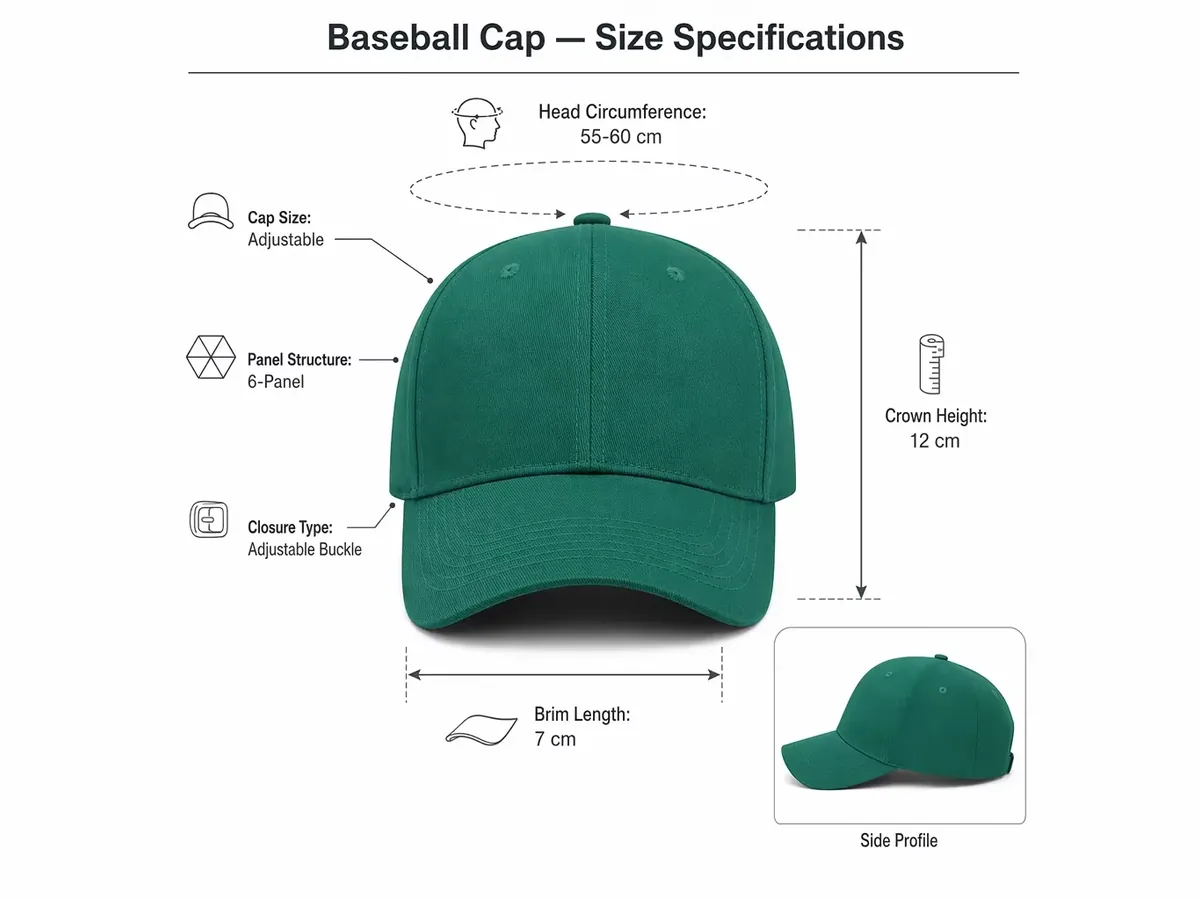
What wholesale custom hats means here
Wholesale custom hats are decorated or blank caps bought in bulk for resale, for a promotional programme or for a brand range — not one-off personalisation. The order is quoted factory-direct by style, colour, decoration, quantity, packaging and destination, so the landed cost can be calculated rather than guessed.
That definition matters because it decides how the order is built. A wholesale buyer is not choosing a cap, they are choosing a spec they can reorder: the same fabric, the same thread colour, the same closure, the same carton. Everything on this page is written around that one requirement.
Who buys wholesale hats, and how each order differs
Distributors buy for stock and care about packing, colour breadth and reorder speed. Promotional buyers buy against a campaign date and care about the artwork proof cycle and delivery certainty. Retail brands buy for a season and care about retail packaging, hang tags and consistency between the sample and the bulk run.
Team and club suppliers buy in smaller quantities per design but in many designs, so the artwork setup dominates their cost. Resellers buying blanks care about carton quantity and the cap being genuinely undecorated so their own decoration is the only thing on it.
The same factory runs all five, but the quotation changes shape. Sending the buyer type with the enquiry is the fastest way to get a usable price, because it tells us which costs to quote separately and which to fold in.
Decorated, blank or private label: three order types
A decorated order carries your logo. The decoration method — flat embroidery, 3D puff, woven or leather patch, screen print, heat transfer, sublimation — follows from the artwork and the fabric, and each method has its own setup and its own position to approve.
A blank order carries nothing. The caps arrive undecorated for you or your decorator to finish. Blank orders are quoted on the cap, the colour split and the packing, with no decoration setup at all, which is why the unit price is lower and the minimum is usually higher.
A private label order carries your brand rather than your logo: a woven label inside the sweatband, your own hang tag, your own carton markings, and sometimes a custom colourway that does not appear anywhere else. Private label is the version that most needs a documented reorder spec, because the value is in the consistency rather than in any one shipment.
Most wholesale programmes mix the three across a season. Which is why the first thing worth confirming is not the price but which of the three order types each line in the range is.
What sets a wholesale unit price
Six things move a wholesale hat price, in roughly this order of size: the cap base and fabric, the decoration method, the number of decoration locations, the packaging, the order quantity, and the shipping method.
The cap base is the largest material cost and the easiest to compare between suppliers, which is why quotations that differ hugely usually differ somewhere else. The decoration is the second largest and the most variable: a single flat-embroidered front logo is one setup, while a front logo plus a side mark plus an inside label is three separate digitizing and positioning jobs.
Packaging is the line item wholesale buyers most often leave out of their own margin calculation. A polybag and a plain master carton is one cost; an individual retail box with a barcode, a hang tag and a size sticker is another, and on a mid-price cap the packaging can approach the cap itself.
Order quantity works in tiers rather than as a straight line, because the setup costs are fixed. Doubling the quantity does not double the price, and the biggest single saving in a wholesale programme usually comes from consolidating two similar lines into one base cap.
MOQ and colour splits in a wholesale order
Minimum order quantity is confirmed per line, not per order. The reason is that every variable in the spec has its own minimum: the cap base, the fabric colour, the thread colour, the decoration method, and the packaging all have a point below which the setup is not economic.
That is why a wholesale enquiry that lists one total quantity usually needs a second round. A thousand pieces across four cap bases is four runs; a thousand pieces on one base in four fabric colours with one decoration is a much simpler job at a much better price.
The practical rule is to hold the base, the closure and the thread colour constant, and vary the fabric colour if variety is needed. Colour variety is cheaper than structure variety, and structure variety is cheaper than decoration variety.
Packaging for distributors and retail
Distributor packing is built around handling: individual polybags, a specified number of pieces per inner and per master carton, a carton mark that matches your warehouse system, and a packing list that reconciles to the order.
Retail packing is built around the shelf: a printed box or a hang tag, a barcode in the format your channel needs, a size or fit label where the product is sized, and a colourway that matches the product photography you will publish.
The two are not interchangeable, and mixing them by accident is a common and expensive mistake: a retail box in a distributor order adds cost without adding value, and a plain polybag in a retail order means the caps cannot be hung or scanned.
We confirm the packing specification in writing with the order, because packing is the one part of a wholesale hat order that is difficult to correct after the goods are made.
Reorder specs: how a wholesale programme stays repeatable
A wholesale hat programme lives or dies on the second order matching the first. That is a documentation problem rather than a manufacturing one, and it is solved by locking the spec before the first run rather than after it.
A locked spec covers the cap base and its measurements, the fabric and its weight, the thread colour, the closure type, the decoration file and its position, the label, the packing, and the carton marking. Once those are recorded, a reorder can be quoted from the spec sheet without re-sampling.
The artwork file is part of the spec. Keeping the digitized stitch file on record means a reorder does not pay for digitizing again, and it means the logo position is repeatable to the millimetre instead of being re-judged from a picture.
If a programme is expected to repeat, say so at the first order. It changes what we keep on file and it usually changes how the sample is documented.
Shipping: forwarder, express, air and sea
We ship to your nominated forwarder or quote freight directly. The three routes behave differently enough that the right answer depends on the deadline rather than the price.
Express is fastest and carries the fewest pieces. It suits sample runs, launch quantities and a first order where the priority is to see the product in market. Air freight sits between express and sea on both cost and transit. Sea freight carries volume at the lowest unit cost and the longest transit, and it is the normal route for a reorder.
Two details change the calculation. The first is carton volume: a cap that packs flat takes fewer cartons than a structured cap that must be protected, so packing affects freight as well as material cost. The second is destination documentation, which we confirm per market rather than assume from another one.
Quality control and pre-shipment photographs
Quality on a wholesale hat order is mostly decided before production: at the sample, where the fabric, the thread colour, the decoration position and the fit are fixed. Everything after that is consistency.
Before the goods leave, finished pieces from the bulk run are photographed. That is the point at which a colour drift, a logo that has moved, or a packing error is still cheap to correct. The photographs are sent with the order rather than kept internally.
Where a material is specified for the order, the material certificate for that material is provided with the shipment. Where a market has its own approval route for the product, testing and documentation are arranged for that market rather than carried over from another one.
How to place a wholesale hat order
Send five things and the quotation is usually right the first time: the cap style or a reference, the quantity, the decoration and its placement, the packing you need, and the destination.
From there we return a factory-direct quotation with the spec, the MOQ per line, the production schedule and the freight options. If the artwork is ready we return a mockup on the actual cap base at the same time.
A sample follows before bulk. Once the sample is approved the bulk run is scheduled, and the reorder spec is recorded so the next order quotes from paper rather than from a photograph.
Buyer Risk Check
Where this project can go wrong
Colour splits are unclear
Wholesale orders usually mix colours, and each fabric colour is its own run with its own minimum. The split has to be confirmed before the price means anything.
Landed cost is incomplete
A unit price without packing, carton volume and freight can mislead a distributor margin. We quote the parts separately so they can be added up.
Reorder spec is not documented
A wholesale programme needs a repeatable spec. If the base, thread colour and decoration file are not locked at the first order, the second one drifts.
Retail and distributor packing get mixed
A retail box in a distributor order adds cost for nothing; a plain polybag in a retail order cannot be hung or scanned. Packing is confirmed in writing with the order.
Sample approved from a flat proof
A flat digital proof cannot show how the crown curves. A physical sample is the only reliable approval step for position and colour.
Parameter Charts
Closure types — fit range and stock risk
| Closure | How it works | Approximate fit range | Stock risk | Typical use |
|---|---|---|---|---|
| Plastic snap (snapback) | Moulded plastic strap with snap positions | Widest — one cap covers most adult head sizes | Lowest — one size covers the order | Most promotional, corporate and event programs |
| Metal snap | Metal strap and snaps, often antique finish | As above | Low, with a premium look | Premium retail and fashion caps |
| Strapback | Fabric strap with a metal slide or buckle | Wide, with an adjustable fabric tail | Low | Dad hats, retail soft-crown caps, casual programs |
| Hook and loop | Velcro-style closure | Wide | Low, but reads as lower cost | Giveaways and budget promotional orders |
| Elastic / stretch band | No adjustment; the band stretches | Moderate — a narrower range per cap | Higher — sizes cannot be fine-tuned after production | Sport caps, youth programs, one-size retail |
| Fitted (sized) | No closure; the cap is made to a specific size | One size per cap | Highest — you must forecast a size run before production | Premium fitted programs, on-field team caps |
Closure choice decides how many head sizes one cap covers. That is why it drives both your unit cost and your leftover inventory.
Decoration method against fabric — what actually works
| Decoration | Cotton twill | Polyester | Acrylic | Canvas | Mesh back | Corduroy |
|---|---|---|---|---|---|---|
| Flat embroidery | Best | Best | Good | Best | Not possible | Good |
| 3D puff embroidery | Best | Good | Risky — may pucker | Best | Not possible | Not suitable |
| Chenille patch | Best | Good | Good | Best | Not possible | Not suitable |
| Woven patch | Best | Best | Best | Best | Possible on solid panels only | Good |
| Leather patch | Best | Good | Good | Best | Not possible | Not suitable |
| PVC / rubber patch | Good | Best | Best | Good | Not possible | Good |
| Screen print | Best | Good | Good | Good | Not possible | Ink sits on the ridges — avoid |
| Heat transfer | Good | Best | Good | Good | Not possible | Avoid |
| Sublimation | Poor — cotton takes no dye | Best | Poor | Poor | Not possible | Poor |
Not every decoration method suits every fabric or every front panel. This is the table to check before you commit a logo to a fabric choice.
Fitted cap sizes against head circumference
| Size | Head circumference (in) | Head circumference (cm) | Usual audience |
|---|---|---|---|
| 6 3/8 | 20 1/4 | 51.5 | Youth / small adult |
| 6 1/2 | 20 3/4 | 52.7 | Youth / small adult |
| 6 5/8 | 21 1/8 | 53.7 | Small adult |
| 6 3/4 | 21 1/2 | 54.6 | Small adult |
| 6 7/8 | 21 7/8 | 55.6 | Small to medium adult |
| 7 | 22 1/4 | 56.5 | Medium — the most common size |
| 7 1/8 | 22 5/8 | 57.5 | Medium adult |
| 7 1/4 | 22 3/4 | 57.8 | Medium to large adult |
| 7 3/8 | 23 1/4 | 59.1 | Large adult |
| 7 1/2 | 23 5/8 | 60 | Large adult |
| 7 5/8 | 24 | 61 | Extra large adult |
| 7 3/4 | 24 3/8 | 61.9 | Extra large adult |
| 8 | 25 1/8 | 63.8 | Extra large / oversize |
Use this to plan a size run. Adjustable caps avoid the problem entirely; fitted caps do not, so the split has to be forecast before production.
Need a combination that is not listed? Send your specand we will confirm what the factory can hold before you commit.
What we confirm before production
Every order is quoted by the actual spec, sampled for approval, and checked against the approved sample before shipping.
Factory-direct quotation
Pricing is built from the actual cap, decoration and packing specification rather than from a list price.
Bulk programme support
Mixed colours, repeat orders, colourway consolidation and distributor packing are normal order shapes here.
Locked reorder spec
The base, fabric, thread colour, decoration file and packing are recorded so a reorder quotes from paper.
Photographs before shipment
Finished goods from the bulk run are photographed and sent before the goods leave the factory.
Freight options compared
Express, air and sea are quoted separately so the landed cost can be compared rather than assumed.
Common questions
Wholesale describes the buying relationship and the volume; custom describes the decoration. A wholesale custom hat order is bulk quantity with your logo, brand or specification applied. The same factory makes wholesale blank caps, which carry no decoration at all and are bought for someone else to finish.
Yes. We manufacture decorated and blank caps for distributors, retailers, promotional buyers, brands and team suppliers, quoted factory-direct by style, colour, decoration, quantity, packing and destination.
Yes, but MOQ and pricing are confirmed per line, because each cap base and each fabric colour is its own production run. Holding one base and varying the colour is far cheaper than varying the structure.
MOQ is confirmed per line rather than as one number, because the cap base, fabric colour, thread colour, decoration method and packaging each have their own minimum. Send the intended split and you get a per-line answer.
Consolidating lines. Holding one cap base, one closure and one thread colour across the order removes setup runs, and the biggest single saving in most programmes comes from merging two similar styles into one base cap.
Yes. We ship to your nominated forwarder, or quote express, air and sea freight separately so the landed cost can be compared. Carton volume is part of that calculation, so packing affects freight as well as material cost.
By locking the spec before the first run: cap base and measurements, fabric and weight, thread colour, closure, decoration file and position, label, packing and carton marking. Once recorded, a reorder is quoted from the spec sheet without re-sampling.
Yes. Private label means your brand rather than your logo: a woven label in the sweatband, your hang tag, your carton markings and where required a colourway that is not used elsewhere. It is the order type that most needs a documented reorder spec.
Flat embroidery, 3D puff, woven, leather and PVC patches, chenille, screen print, heat transfer and sublimation. The method follows from the artwork and the fabric, and each one has its own setup and its own position to approve on the sample.
Quality is decided at the sample, where fabric, thread colour, decoration position and fit are fixed. Before shipment, finished pieces from the bulk run are photographed and the photographs are sent with the order, which is the point at which a drift is still cheap to correct.
Yes. Blank caps are quoted on the cap, the colour split and the packing with no decoration setup, which lowers the unit price and usually raises the minimum. Carton quantity is confirmed per style.
The schedule is set after sample approval and depends on the cap base, decoration, quantity and packing. It is confirmed on your order rather than quoted as a general figure, because consolidation across lines changes it.
Ready to quote this project?
Send your cap style, logo, quantity and destination. We will reply with MOQ, unit price, sample details and shipping options.
Undecorated caps for decorators and distributors.
Private Label HatsRetail-ready hats under your own brand.
Custom Hat MOQHow minimums are confirmed per line.
Custom Hat Cost GuideWhat moves the unit price on a bulk order.
Promotional HatsBulk branded caps for campaigns.
Custom Hat Sample ProcessProof, sample and approval before bulk.
Custom Baseball HatsThe base most wholesale programmes start from.
Custom Trucker HatsThe other volume base for trucker programmes.
Our FactoryWhere the caps are made.
Request a QuoteSend the split, packing and destination.