Use Case
Promotional Hats Manufacturer
Custom promotional hats for giveaways, trade shows, product launches, brand activations and corporate campaigns. We help choose a cap style, logo method, packing plan and shipping option that fits your deadline and budget.
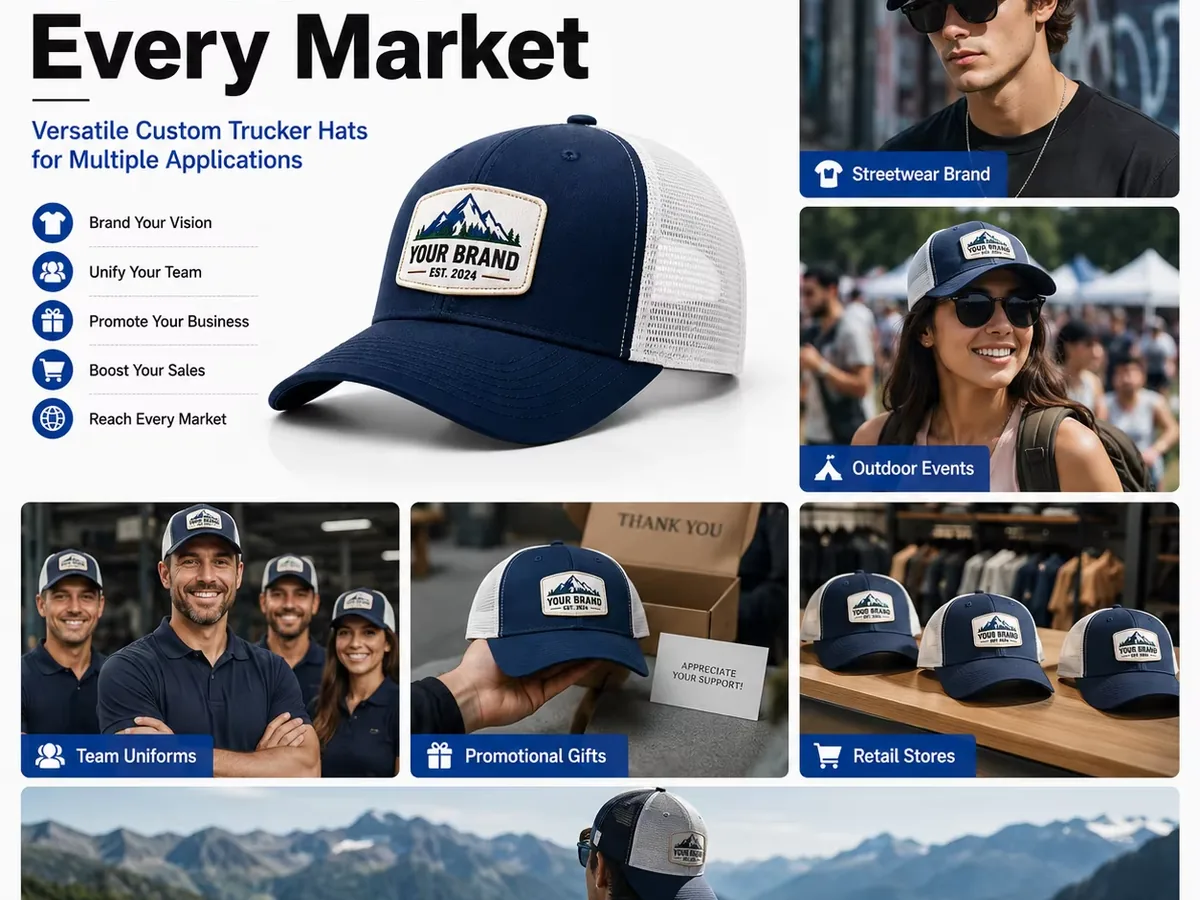
Giveaway caps that people actually keep
Promotional hats work best when they feel useful, not disposable. A clean cap style, readable logo and comfortable fit make the difference between a giveaway that gets worn and one that stays in a box.
For campaigns, the key decisions are quantity, deadline, logo method, packaging and distribution. A simple embroidered baseball cap may work for corporate buyers, while a printed five-panel cap may fit a youth event or launch.
We quote promotional hats by the actual campaign requirements, including carton packing, delivery destination and whether you need individual bags or bulk event packing.
Choosing between a $2 cap and a cap worth keeping
The promotional cap market runs from very cheap single-use caps to caps a recipient keeps for years, and the difference is not the logo — it is the base. A structured six-panel cap with fused front panels holds its shape after the first wear; an unstructured cap with a thin fabric collapses and reads as cheap within a week.
Three construction details decide which one you are buying: the front panel (fused and lined, or single-layer), the sweatband (cotton twill, or a thin polyester strip), and the closure (metal slide or snapback, or a plastic strap). Each one is a cost line, and each one is visible to the recipient without them knowing the vocabulary.
For a campaign where the cap is the giveaway at a trade show, the cheap end is rational: most caps leave in a bag and are never worn twice. For staff uniforms, customer gifts or a launch where the brand is judged by the object, the structured version is what stops the cap from becoming a joke photo.
The logo methods, and what each one costs you
Embroidery is the default: durable, reads as premium and adds texture. It is priced by stitch count, so a 4,000-stitch wordmark costs less than an 8,000-stitch crest. Small text is where embroidery fails — below roughly 6 mm cap height, letters fill in, and the fix is either a bigger logo or a different method.
Screen print gives a flat, bold result and suits one or two solid colours on a smooth fabric. Heat transfer holds photographs and gradients but sits on the surface, so it can crack at the edges over time. A woven patch handles a detailed crest better than thread and is often the cheapest way to get a complex logo onto a cheap base cap.
The mistake that costs the most is choosing the method before looking at the artwork. A five-colour crest on a 2 cm area cannot be embroidered cleanly; the same crest as a woven patch is fine. Send the vector file before deciding and the method follows from the artwork instead of the other way round.
How promotional pricing actually works
Promotional caps are priced on quantity first. Our minimum is 50 pieces per style and colour, and price steps sit at roughly 100, 500 and 1,000 pieces. Below 100 pieces you are paying for setup spread over few units; at 1,000 the same cap drops to its floor price because setup is amortised across the run.
The second lever is decoration area and method. One front logo is the baseline; adding a back mark, a side logo or a sleeve print adds a setup and a run cost for each position. Three positions on 100 caps often costs more than one position on 300 — worth checking before you commit to more logos than the campaign needs.
The third lever is packing and delivery. Bulk cartons are cheapest. Individual polybags, hangtags and size-grouped cartons add labour and material, but they are what makes an event hand-out work. Air freight is priced by volume, and caps are bulky: a carton of 100 caps is a real shipping input, so the destination and date belong in the first enquiry, not the last.
Working backward from the event date
A promotional order has four gates: artwork proof (1–2 working days), sample (5–10 working days), production (25–35 working days after approval), and shipping. Add the shipping lane to that and you have the earliest date the caps can be in hand.
For an event, the date that matters is when the caps must arrive at the venue or the warehouse — not when they leave the factory. If the event is inside six weeks, tell us the date in the first message: sometimes the schedule holds, sometimes the honest answer is that a simpler decoration or a stock colour is the only way to make it.
Repeat campaigns are easier the second time. Once the specification is approved we keep it on file, so the next order re-runs the same base, colour and logo position without a new sample round — which is usually what turns a one-off giveaway into an annual program.
Buyer Risk Check
Where this project can go wrong
Deadline is not planned early
Sampling, production and shipping need to be counted backward from the event date.
Logo is too subtle
Promotional caps need readable branding from normal viewing distance.
Packing does not match distribution
Event giveaways and retail-style campaigns need different packing plans.
Too many logo positions
Each extra position adds a setup; three positions on 100 caps can cost more than one on 300.
Decoration chosen before artwork
A five-colour crest on a 2 cm area cannot be embroidered cleanly — check the artwork first.
What we confirm before production
Every order is quoted by the actual spec, sampled for approval, and checked against the approved sample before shipping.
Campaign-fit style choice
We match cap style and logo method to audience and budget.
Deadline planning
Production and shipping are scheduled around your campaign date.
Simple distribution
Packing can be set up for events, teams or warehouse delivery.
Sample approval
A sample confirms logo size and cap quality before bulk production.
Repeatable spec
The approved specification is kept on file for next year’s run.
Common questions
Baseball caps, trucker hats and dad hats are common because they fit broad audiences and keep logo placement simple.
Yes. We can use bulk cartons, polybags or labeled cartons depending on the distribution plan.
Start as early as possible so there is time for artwork proof, sample approval, production and shipping.
50 pieces per style and colour, with price steps at about 100, 500 and 1,000 pieces.
Front, back, side and sleeve are all possible, but each position adds a setup and a per-piece cost.
About 6 mm cap height. Below that, letters fill in — a woven patch or a larger logo works better.
Yes. Front, back, inside label and a close-up of the decoration are photographed before the goods leave.
Ready to quote this project?
Send your cap style, logo, quantity and destination. We will reply with MOQ, unit price, sample details and shipping options.