B2B Buying Reference
Cap Specifications: The Six Parameters That Define a Custom Hat
A custom cap is defined by six parameters — panel count, crown profile, back construction, closure, bill shape and fabric. Change one and the cap, the price and the decoration options all change with it. These charts are the reference we use when we quote.
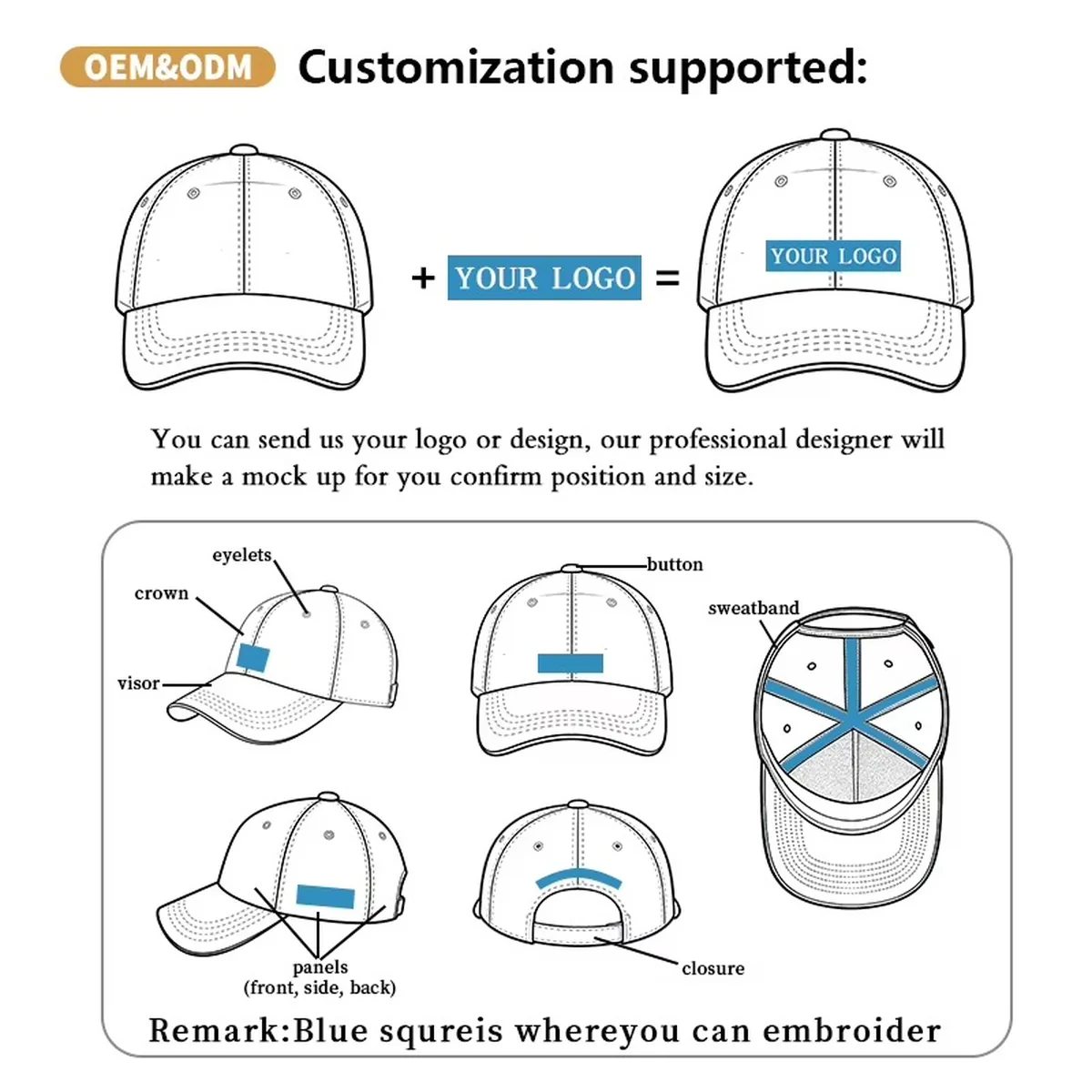
Why cap specifications matter more than the style name
Two caps can both be called a "baseball cap" and still be different products. One has six panels and a mid crown; the other has five panels and a low crown. One has a solid back and takes full embroidery; the other has a mesh back that cannot hold a stitch at all.
That is why style names alone are a poor basis for a quote. A cap is really a set of six decisions, and each one has a consequence — on the look, on what decoration is possible, on how many head sizes one cap covers, and on the unit cost.
The charts below are the same reference we use internally when we review a specification. If you are writing a brief or filling in an RFQ, work through them in order and your spec will be quotable without a round of questions.
The order we recommend working through them
Start with the fabric, because it decides which decoration methods are available. Then choose panel count, which sets the size of your front logo area. Then profile and structure, which decide whether the cap reads as corporate, casual or streetwear.
After that come the closure and the bill. The closure is the commercial one — it decides whether one size covers your whole order or whether you have to forecast a size run before production. The bill is the fastest way to date a design, so it is usually the last thing to finalise.
If your order is influenced by a specific reference cap, send a photo alongside the drawing. Matching a photo plus these six parameters is faster and more accurate than describing it in words.
How to use these tables in a quote request
You do not need to fill in every field. The minimum we need to quote accurately is: fabric, panel count, closure type, decoration method, quantity and your logo file. Anything you leave open, we will recommend and explain in the DFM response.
Where a combination in these tables is marked as not possible or risky, it genuinely is — usually because the mesh cannot carry a stitch, or the pile of the fabric swallows fine detail. We would rather tell you that at quotation than after the goods are made.
Buyer Risk Check
Where this project can go wrong
Specifying a mesh back and a back logo
Mesh cannot hold embroidery. If the logo has to appear on the back, the back has to be solid.
Choosing a closure that was never sized for the audience
A fitted cap needs a forecast size run. An adjustable cap does not. Getting this wrong shows up as unsold stock.
Picking a fabric after the decoration method
Sublimation only works on polyester-rich fabric. Committing to cotton first can rule out the finish you wanted.
Cap panel count — construction and what it changes
| Panels | Construction | Front logo area | Crown character | Typical use |
|---|---|---|---|---|
| 5-panel | Five panels, front is one wide panel or a split pair | One broad flat area — widest and tallest usable front space | Lower and flatter, casual, sits close to the head | Streetwear, camper caps, wide wordmark or full-front logos |
| 6-panel | Six panels, symmetric front pair with a centre seam | Two front panels with a centre seam — smaller than 5-panel but symmetric | The industry default; balanced height and shape | Baseball caps, trucker caps, corporate and event hats |
| 6-panel seamless | Six panels with a bonded or laser-cut front, no visible front seam | Continuous flat front with no seam line crossing the artwork | Same as 6-panel but a cleaner face | Full-front prints, sublimation, large detailed artwork |
| 7-panel / multi-panel | More panels, minor seams, rounder crown | Similar to 6-panel, often narrower | Rounded and closer-fitting | Specialty and fashion shapes; confirm per style |
Panel count decides the seam layout, how much flat front area you get for a logo, and how the crown sits. It is usually the first thing a buyer specifies.
Crown profile — height and structure
| Profile | Crown height | Structure | How it wears | Typical use |
|---|---|---|---|---|
| Low profile | Shallow, roughly 3.5 in / 89 mm | Usually unstructured | Sits low and close; soft, relaxed look | Dad hats, casual retail, garment-washed styles |
| Mid profile | Standard, roughly 4 in / 102 mm | Structured or unstructured | The balanced default that suits most wearers | Most corporate, promotional and team caps |
| High profile / high crown | Taller, roughly 4.5 in / 114 mm | Structured | More volume above the head; reads as streetwear | Flat-brim snapbacks, fashion and music merchandising |
| Unstructured (soft crown) | Varies | No buckram in the front panels | Collapses flat, packs well, soft against the forehead | Giveaways, travel, retail-soft looks, low-profile dad hats |
| Structured | Varies | Buckram-backed front panels | Holds a crisp shape, keeps a flat face for embroidery | 3D puff embroidery, trucker caps, premium corporate programs |
Profile is the crown height and whether the front panels are backed. Two caps with the same panel count and the same fabric can look completely different because of this.
Back construction — mesh against solid
| Back | Material | Breathability | Decoration | Typical use |
|---|---|---|---|---|
| Mesh back | Polyester mesh over the rear panels | Highest — open mesh vents heat | Not embroiderable; the mesh cannot hold a stitch | Trucker caps, outdoor work, warm climates, event giveaways |
| Solid back | Same fabric as the front | Lower, but warmer in cold weather | Fully embroiderable and printable | Baseball caps, dad hats, corporate and retail caps |
| Performance back | Wicking knit, often with stretch | High — moves moisture rather than venting | Light embroidery only; check the knit | Running, golf, sport and activewear programs |
The back is the single biggest visual and comfort difference between a trucker cap and a baseball cap, and it decides whether the back can carry decoration.
Closure types — fit range and stock risk
| Closure | How it works | Approximate fit range | Stock risk | Typical use |
|---|---|---|---|---|
| Plastic snap (snapback) | Moulded plastic strap with snap positions | Widest — one cap covers most adult head sizes | Lowest — one size covers the order | Most promotional, corporate and event programs |
| Metal snap | Metal strap and snaps, often antique finish | As above | Low, with a premium look | Premium retail and fashion caps |
| Strapback | Fabric strap with a metal slide or buckle | Wide, with an adjustable fabric tail | Low | Dad hats, retail soft-crown caps, casual programs |
| Hook and loop | Velcro-style closure | Wide | Low, but reads as lower cost | Giveaways and budget promotional orders |
| Elastic / stretch band | No adjustment; the band stretches | Moderate — a narrower range per cap | Higher — sizes cannot be fine-tuned after production | Sport caps, youth programs, one-size retail |
| Fitted (sized) | No closure; the cap is made to a specific size | One size per cap | Highest — you must forecast a size run before production | Premium fitted programs, on-field team caps |
Closure choice decides how many head sizes one cap covers. That is why it drives both your unit cost and your leftover inventory.
Bill and brim options
| Bill | Shape | Shade | Look | Notes |
|---|---|---|---|---|
| Curved bill | Pre-curved downwards | Good — covers the eyes | Classic, sporty, safe for corporate | The default on baseball and trucker caps |
| Flat bill | Straight across, worn flat or bent by the wearer | Less until the wearer bends it | Streetwear and fashion | Often paired with a high crown and a snapback |
| Flex bill | Bendable insert, shapeable by hand | Adjustable by the wearer | Modern streetwear | Lets one cap satisfy both flat and curved preferences |
| Sandwich bill | A contrast layer between the bill layers | Same as the base bill | Adds a second brand colour on the edge | Common on team and retail caps; adds a construction step |
| Visor only | No crown; an open band with a bill | Good | Sport, golf, tennis | Lighter and cooler; no crown decoration area |
Bill shape is the second-fastest way to date a cap after the crown. It also changes how much shade the cap gives and how the front reads.
Cap fabrics — how they behave and what they cost you
| Fabric | Hand feel | Colour and shape | Embroidery result | Best for |
|---|---|---|---|---|
| Cotton twill | Soft, classic; softens further with wear | Colour holds well but fades with heavy washing; can crease | Excellent — the standard surface for flat and 3D embroidery | Corporate, retail and team caps where the logo matters |
| Acrylic | Wool-like and slightly crisp | Holds shape and colour strongly; resists fading | Good, but dense stitching can pucker a thin acrylic | Beanies, wool-look caps, budget retail |
| Polyester | Smooth, slightly synthetic | Very colourfast; resists shrinking | Good — but use a compatible backing for dense logos | Performance caps, sublimation, hard-wearing work caps |
| Cotton / polyester blend | Between the two | Better shape retention than pure cotton with more softness than pure polyester | Very good | The all-round choice for mixed programs |
| Brushed cotton | Soft, slightly fuzzy, washed look | Softer handle, colour looks muted by design | Good; the texture softens fine detail | Dad hats, lifestyle and garment-washed styles |
| Canvas | Heavy and firm | Holds a structured shape very well | Very good; takes heavy stitch counts | Structured caps, workwear, premium retail |
| Corduroy | Textured vertical ridges | Rich colour, seasonal look | Usable, but the pile hides fine detail — keep logos bold | Autumn and winter retail, fashion programs |
| Performance knit | Light, stretchy, smooth | Wicking and fast-drying | Light logos only; dense fill distorts the knit | Running, golf, cycling and sport |
| Recycled polyester | Same as polyester | Same as polyester, with a sustainability story | Same as polyester | Brands with a sustainability requirement |
Fabric drives hand feel, colour retention, breathability and how well your logo reproduces. Ask for the fabric weight and composition to be confirmed on the order sheet.
Decoration method against fabric — what actually works
| Decoration | Cotton twill | Polyester | Acrylic | Canvas | Mesh back | Corduroy |
|---|---|---|---|---|---|---|
| Flat embroidery | Best | Best | Good | Best | Not possible | Good |
| 3D puff embroidery | Best | Good | Risky — may pucker | Best | Not possible | Not suitable |
| Chenille patch | Best | Good | Good | Best | Not possible | Not suitable |
| Woven patch | Best | Best | Best | Best | Possible on solid panels only | Good |
| Leather patch | Best | Good | Good | Best | Not possible | Not suitable |
| PVC / rubber patch | Good | Best | Best | Good | Not possible | Good |
| Screen print | Best | Good | Good | Good | Not possible | Ink sits on the ridges — avoid |
| Heat transfer | Good | Best | Good | Good | Not possible | Avoid |
| Sublimation | Poor — cotton takes no dye | Best | Poor | Poor | Not possible | Poor |
Not every decoration method suits every fabric or every front panel. This is the table to check before you commit a logo to a fabric choice.
Need a combination that is not listed? Send your specand we will confirm what the factory can hold before you commit.
What we confirm before production
Every order is quoted by the actual spec, sampled for approval, and checked against the approved sample before shipping.
One spec sheet per order
We confirm all six parameters in writing before sampling, so the sample and the bulk run cannot drift apart.
Decoration checked against fabric
We tell you before sampling if your logo cannot be reproduced on the fabric you chose.
Size plan support
For fitted caps we help work out a size split that matches your audience instead of guessing.
Sample before bulk
Nothing goes into production until you have approved a physical sample against the specification.
Common questions
Panel count, crown profile and structure, back construction, closure type, bill shape, and fabric. Decoration method is chosen against those six, not instead of them.
It changes the number of cut pieces and seams, so it affects labour. The bigger cost driver is usually the fabric and the decoration, but panel count is part of the calculation.
No. Polyester mesh cannot hold embroidery or a printed transfer. If the logo must appear on the back, the back panel has to be solid fabric.
A plastic snapback. One cap adjusts across most adult head sizes, which is why it dominates promotional and corporate orders. Fitted caps cover one size each.
Structured caps have buckram backing in the front panels, so the crown holds a crisp shape and gives a flat face for embroidery. Unstructured caps have no backing: they are softer, pack flat, and read as casual.
Yes, but it is an unusual combination. Flat bills are normally paired with a mid or high crown, because a low crown and a flat bill tend to look dated rather than deliberate.
Cotton twill or canvas on a structured front panel. Thin acrylic can pucker under a dense 3D fill, and corduroy pile hides the relief you are paying for.
Yes. The confirmed specification travels with the order, and the bulk run is checked against the approved sample rather than against a verbal description.
Ready to quote this project?
Send your cap style, logo, quantity and destination. We will reply with MOQ, unit price, sample details and shipping options.
5-panel against 6-panel, and what the front logo area really looks like.
Cap Closure GuideSnapback, strapback, elastic and fitted — and the stock risk behind each.
Cap Fabric GuideHow each fabric behaves on the head and under the needle.
Decoration CompatibilityWhich logo method works on which fabric, and which combinations fail.
Hat Size GuideSizing, fitted size runs and youth fit.
Request a QuoteSend your spec and logo for a factory-direct quote.