Specification Guide
Cap Embroidery Stitch Guide: Count, Density and Detail
Stitch count is the number that links artwork to embroidery cost. It is also the reason two logos of the same size can quote very differently — and the reason some artwork has to be simplified before it can be stitched.
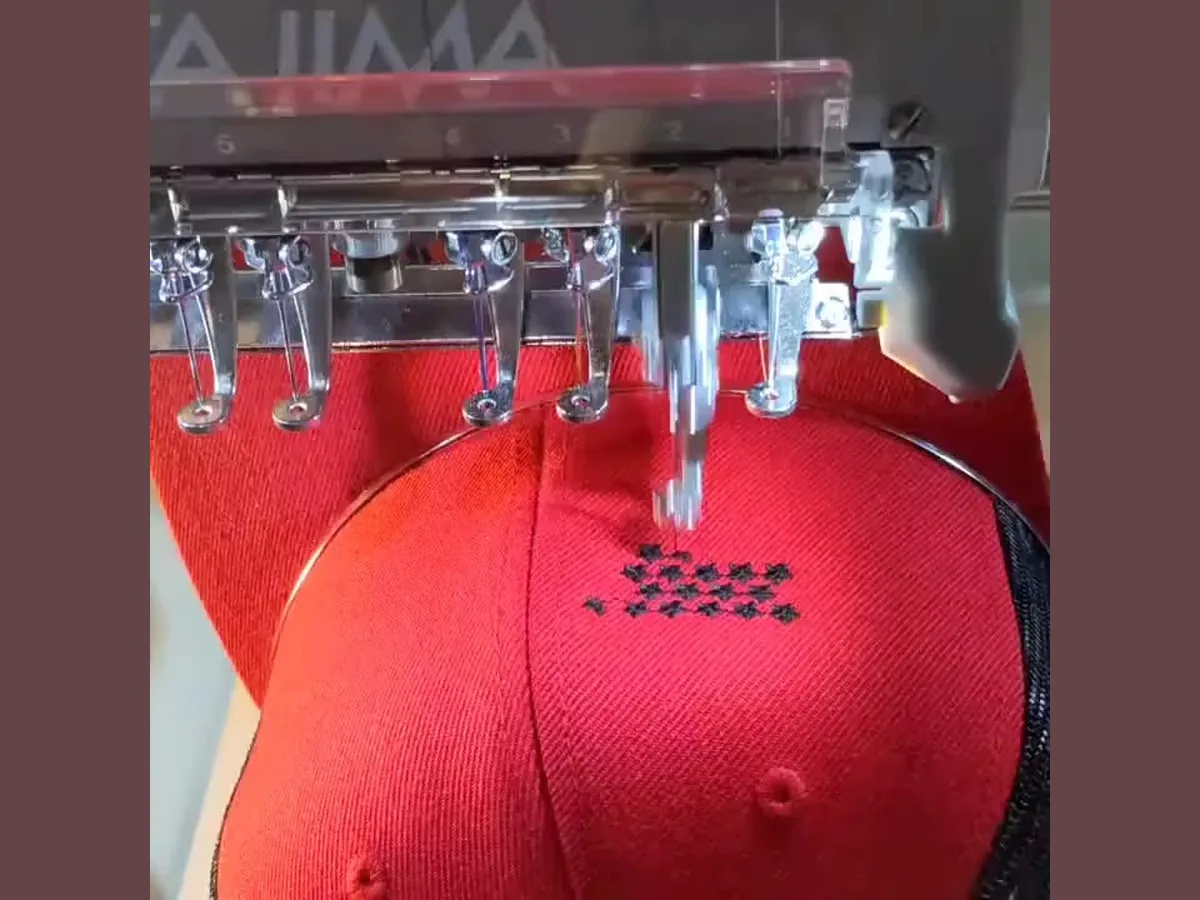
What stitch count is
Stitch count is the number of needle penetrations a design requires. It is calculated from the artwork by digitising software, and it drives machine time directly: more stitches means longer on the machine and a higher unit cost.
Size is the biggest driver. Doubling the width of a logo roughly quadruples its area, and stitch count scales with area rather than with the outline.
Density is the second driver. Fill stitches are laid close together to cover an area; if they are too close the fabric is over-penetrated and the panel can pucker, too far apart and the base fabric shows through.
Why artwork sometimes has to be simplified
Thread is thicker than ink. A line that would print at half a millimetre becomes a blob when stitched, and letters below a certain size close up into shapes.
The usual simplification is to drop fine outlines, thicken the remaining strokes, and replace small text with a cleaner typeface at a larger size. We show you the simplified version before anything is stitched.
Photographic gradients cannot be reproduced in stitch at all. They go to print or sublimation instead — that is a method decision, not a stitch-plan decision.
Getting a clean result
Send vector artwork. Vector scales without loss, which lets us digitise at the size you actually want rather than cleaning up a small raster image.
Choose the fabric with the stitch in mind. Dense fills sit best on a structured cotton twill or canvas front. Thin acrylic and soft unstructured fronts can pull.
If 3D puff is planned, say so before digitising. Puff is stitched over a foam layer and needs a different underlay and a slightly different density plan than flat embroidery.
Buyer Risk Check
Where this project can go wrong
Fine lines in the artwork
Thread is thicker than ink, so thin strokes and small text close up when stitched.
Gradients and photographic fills
Stitch cannot reproduce a gradient. That design belongs to print or sublimation.
Too dense a fill on a soft front
Over-penetration pulls the fabric and puckers the panel, especially without rigid backing.
Planning 3D puff after digitising
Puff needs a different underlay and density plan, so the digitising has to be redone.
Parameter Charts
Decoration method against fabric — what actually works
| Decoration | Cotton twill | Polyester | Acrylic | Canvas | Mesh back | Corduroy |
|---|---|---|---|---|---|---|
| Flat embroidery | Best | Best | Good | Best | Not possible | Good |
| 3D puff embroidery | Best | Good | Risky — may pucker | Best | Not possible | Not suitable |
| Chenille patch | Best | Good | Good | Best | Not possible | Not suitable |
| Woven patch | Best | Best | Best | Best | Possible on solid panels only | Good |
| Leather patch | Best | Good | Good | Best | Not possible | Not suitable |
| PVC / rubber patch | Good | Best | Best | Good | Not possible | Good |
| Screen print | Best | Good | Good | Good | Not possible | Ink sits on the ridges — avoid |
| Heat transfer | Good | Best | Good | Good | Not possible | Avoid |
| Sublimation | Poor — cotton takes no dye | Best | Poor | Poor | Not possible | Poor |
Not every decoration method suits every fabric or every front panel. This is the table to check before you commit a logo to a fabric choice.
Need a combination that is not listed? Send your specand we will confirm what the factory can hold before you commit.
What we confirm before production
Every order is quoted by the actual spec, sampled for approval, and checked against the approved sample before shipping.
Stitch count shown before quoting
We digitise first and tell you the count, so the cost is explained rather than just presented.
Simplification shown to you
If the artwork has to be simplified, you see the simplified version before it is stitched.
Method redirected when needed
If the artwork suits print or a patch better, we say so instead of stitching something that will disappoint.
Artwork proof first
A digital proof is issued before any physical sampling.
Common questions
It is the number of needle penetrations the design requires. It is calculated when the artwork is digitised and it drives machine time, which is why it affects price.
It depends entirely on size and density. A small one-colour mark and a large multi-colour fill can differ by an order of magnitude, which is why we digitise before quoting.
Thread is thicker than ink. Below a certain size, letters close into a shape. Enlarging the text or switching to a cleaner typeface fixes it.
No. Stitch lays solid thread. Gradients and photographic artwork go to print or sublimation, where colour can transition.
Yes, directly — more stitches means more machine time. Area is the main driver, so enlarging a logo increases cost faster than most buyers expect.
3D puff is stitched over a foam layer so the logo stands off the panel. It needs a different underlay and density plan and suits a structured front panel.
Vector is best because it scales without loss. Send the largest file you have and we will tell you what detail is achievable.
Send the reference and we will match against the available thread range. Exact matches depend on the colour and the fabric.
Ready to quote this project?
Send your cap style, logo, quantity and destination. We will reply with MOQ, unit price, sample details and shipping options.
Raised embroidery on structured fronts.
Custom EmbroideryFlat and 3D embroidery on custom headwear.
Embroidery vs Patch vs PrintChoosing between the three decoration families.
Cap Decoration GuideWhich method works on which fabric.
Cap Fabric GuideWhich fabrics carry a dense fill cleanly.
Request a QuoteSend artwork for digitising and a quote.