Buyer Comparison
Embroidery vs Patch vs Printing: Choosing Cap Decoration
There are three families of cap decoration: stitch, applied badge and print. Each one has a different cost curve, a different minimum, and a different list of fabrics it refuses to work on. This page puts them side by side.
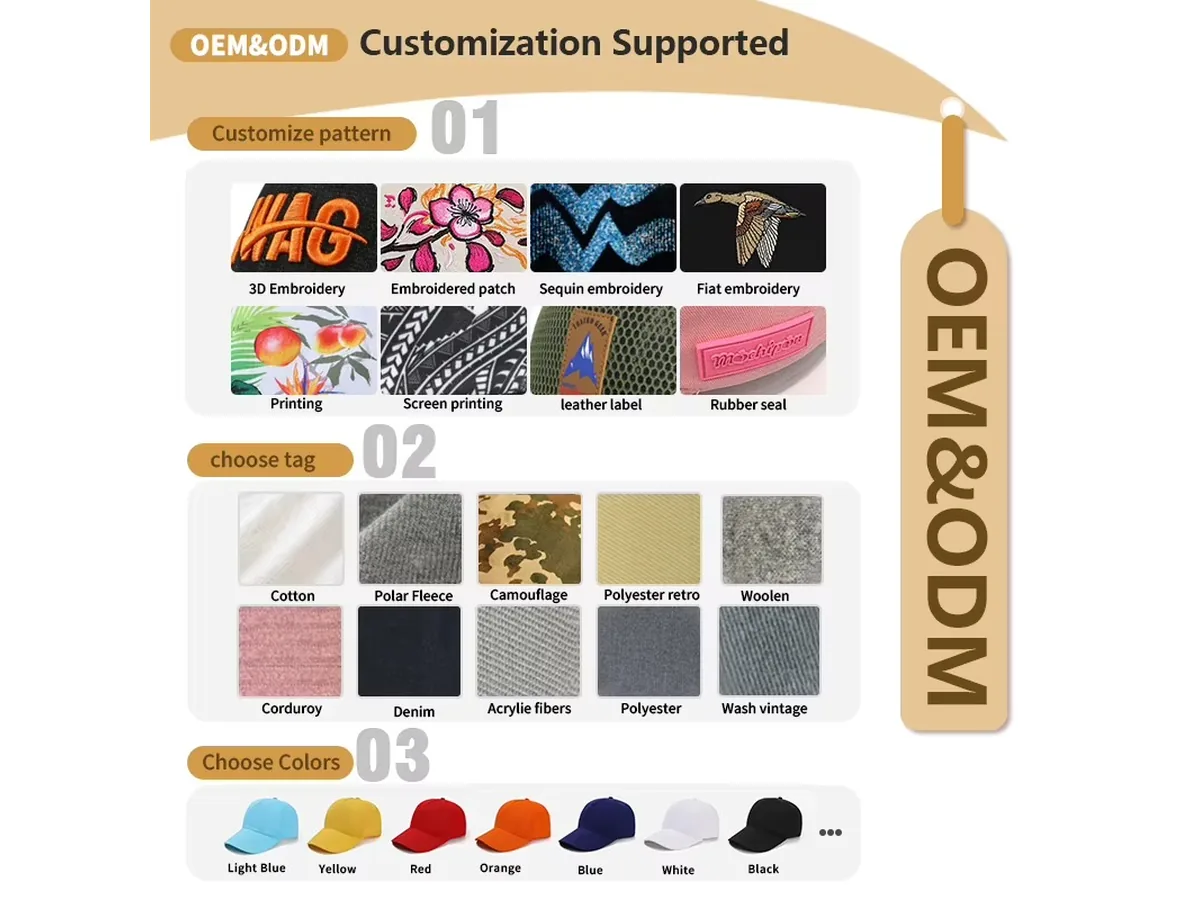
The three families
Stitch decoration covers flat embroidery, 3D puff and chenille. It is the default for corporate, team and promotional headwear because it is durable, needs no additional material, and reads clearly from a distance.
Applied decoration covers woven patches, leather patches and PVC patches. A badge is produced separately and attached. It is chosen when the artwork has fine detail or many colours that stitching cannot reproduce economically.
Print decoration covers screen print, heat transfer and sublimation. It is chosen for photographic artwork, gradients and all-over patterns. It is also the family with the most fabric restrictions.
What actually decides the method
Detail density comes first. Stitching simplifies fine detail: thin lines close together fill in and small text becomes a shape rather than a word. If the artwork has fine lines or text under a few millimetres, a patch or a print reproduces it more faithfully.
Colour count comes second. Each additional thread colour in embroidery is a separate setup, so artwork with many colours gets expensive quickly. Print handles unlimited colours at no extra setup cost.
Fabric comes third and it is the one that rules methods out entirely. Polyester mesh cannot hold a stitch or a transfer. Sublimation only works on polyester-rich fabric. Corduroy pile swallows fine relief. The compatibility table below is the reference we use internally.
How we recommend choosing
For a logo with strong shapes and up to four colours, embroidery is normally the right answer on any woven fabric — it survives washing, wear and handling, and it needs no extra component.
For a logo with fine detail, gradients or photographic elements, look at sublimation if the fabric can be polyester-rich, or a woven patch if the base fabric has to stay cotton.
If your artwork is undecided, send it before choosing a method. Recommending a decoration that the chosen fabric cannot carry is the most expensive mistake in this process, and it is the one we check first.
Buyer Risk Check
Where this project can go wrong
Specifying embroidery for fine artwork
Thin lines and small text fill in with thread. The result is a shape, not a readable logo.
Choosing a heavy 3D fill on thin fabric
Dense puff on a thin or unstable fabric puckers the panel. Fabric is chosen before the stitch style.
Committing to cotton before deciding decoration
Sublimation needs polyester-rich fabric. Choosing cotton first can rule out the finish you actually wanted.
Putting a logo on a mesh back
Polyester mesh cannot hold embroidery or a transfer. If the back must carry a logo, the back panel has to be solid.
Parameter Charts
Decoration method against fabric — what actually works
| Decoration | Cotton twill | Polyester | Acrylic | Canvas | Mesh back | Corduroy |
|---|---|---|---|---|---|---|
| Flat embroidery | Best | Best | Good | Best | Not possible | Good |
| 3D puff embroidery | Best | Good | Risky — may pucker | Best | Not possible | Not suitable |
| Chenille patch | Best | Good | Good | Best | Not possible | Not suitable |
| Woven patch | Best | Best | Best | Best | Possible on solid panels only | Good |
| Leather patch | Best | Good | Good | Best | Not possible | Not suitable |
| PVC / rubber patch | Good | Best | Best | Good | Not possible | Good |
| Screen print | Best | Good | Good | Good | Not possible | Ink sits on the ridges — avoid |
| Heat transfer | Good | Best | Good | Good | Not possible | Avoid |
| Sublimation | Poor — cotton takes no dye | Best | Poor | Poor | Not possible | Poor |
Not every decoration method suits every fabric or every front panel. This is the table to check before you commit a logo to a fabric choice.
Need a combination that is not listed? Send your specand we will confirm what the factory can hold before you commit.
What we confirm before production
Every order is quoted by the actual spec, sampled for approval, and checked against the approved sample before shipping.
Method checked against fabric
We confirm the decoration and the fabric are compatible in writing before sampling.
All three families in-house
Stitch, applied badge and print are all evaluated for the same artwork rather than steered to whichever is available.
Honest detail limits
If your artwork has to be simplified, we show you the simplified version before you approve it.
Artwork proof first
A digital proof is issued before any physical sampling, so the layout is agreed early.
Common questions
Embroidery and applied badges outlast print under repeated washing. Print is not fragile, but it is a surface layer rather than part of the fabric.
Not faithfully. Stitching simplifies photographic detail into shapes. Photographic artwork is better served by sublimation or a printed transfer.
3D puff uses a raised foam layer under the stitches so the logo stands off the panel. Flat embroidery sits flush with the fabric. 3D puff needs a structured front panel and forgiving fabric.
Each thread colour requires its own setup on the machine. More colours means more setup passes per cap, which is why multicolour artwork is often cheaper as a patch or a print.
All-over and photographic designs on polyester-rich fabric. It dyes into the material, so there is no raised surface and no colour limit.
It needs a flat, stable front panel to sit on. Leather patches on a soft unstructured crown tend to look uneven because there is nothing behind them.
Yes. Front embroidery with a printed side or a woven back label is common. Each method is quoted and sampled as part of the same specification.
Vector artwork is best because it scales without loss. If you only have a raster file, send the largest version you have and we will tell you what is achievable.
Ready to quote this project?
Send your cap style, logo, quantity and destination. We will reply with MOQ, unit price, sample details and shipping options.
Which method works on which fabric, and which combinations fail.
Custom EmbroideryFlat and 3D embroidery on custom headwear.
Patch HatsWoven, leather and PVC badge options.
Printed HatsScreen print and heat transfer headwear.
Embroidery Stitch GuideStitch counts, density and what they change.
Request a QuoteSend artwork for a method recommendation and a quote.