Decoration Method
Custom Sublimation Hats
Sublimation hats for all-over patterns, photographic artwork and full-color polyester panels. We confirm fabric, panel layout, print scale and sample color before bulk production.
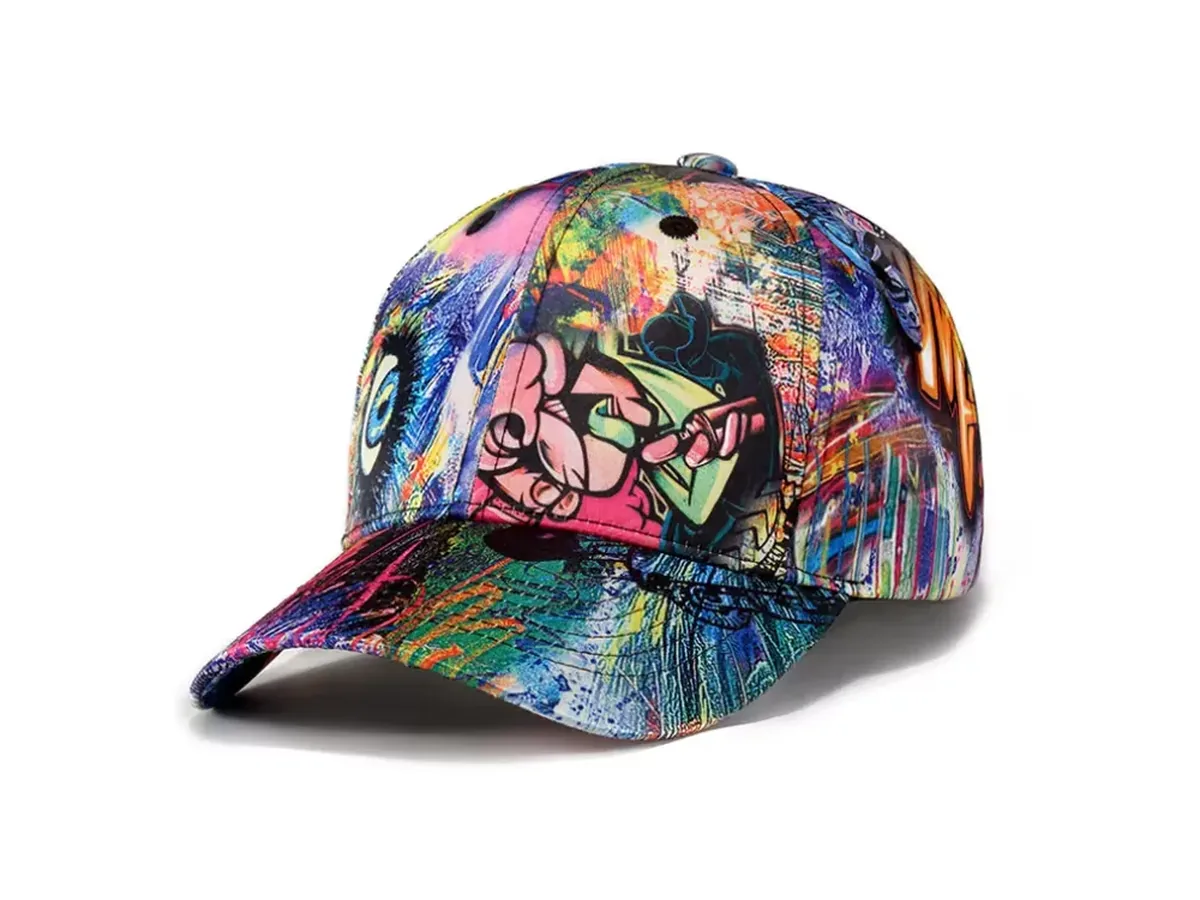
Full-color print built into the fabric
Sublimation bonds the artwork into polyester fabric, so it does not sit on top like ink or transfer film. It is a strong option for all-over prints, repeat patterns and performance-style caps.
The method works best on polyester or polyester-rich panels. Cotton is not a good sublimation base, so fabric choice must be confirmed before artwork planning.
Panel layout matters because seams break up the print. Five-panel caps and flat panels often give the cleanest area for large artwork.
How the process actually runs
The artwork is printed onto transfer paper with sublimation inks, then pressed onto the cut fabric panels at around 190–200 °C. Under heat the ink turns to gas and bonds into the polyester fibre, which is why the print has no hand feel and cannot peel: there is no layer on the surface to lift.
The consequence is that the fabric is printed before the cap is sewn. Panels are cut, printed, then assembled — so the print position is decided at the cutting stage, not after the cap exists. That is why we ask for the panel layout before quoting: a six-panel crown has six pieces of fabric to place artwork across, and a five-panel crown has fewer seams cutting through the design.
Only the polyester parts take the print. A cap with a cotton sweatband, a metal buckle or a mesh back that is not polyester will show those parts in their own colour, so the design has to account for them from the start.
Where sublimation beats embroidery, and where it does not
Sublimation wins when the artwork has gradients, photographs, many colours, or repeats across the whole cap. Embroidery cannot hold a photographic gradient: each colour is a thread, and fine detail disappears into stitch width. Screen print and heat transfer can hold colour but sit on the fabric, so they feel different and can wear at the edges.
Embroidery wins when the logo is small, tight and needs to look premium — a crest on a front panel, a wordmark on the side. Thread has texture and perceived value that print does not, and it survives washing differently.
A common compromise: sublimated all-over pattern on the crown, embroidered logo on top of it. That requires the embroidery to be digitised for a printed background (the needle path has to sit cleanly over the print), so confirm the sequence with the sample rather than assuming it.
What drives the price
Print coverage is the main cost driver. One printed front panel costs less than a full all-over print, because the transfer paper and pressing time scale with the printed area. If your design only needs a pattern on the front, say so — full-wrap printing runs the cost up for no visible gain at the back.
Fabric choice is the second driver. A polyester twill that takes print well costs more than a basic poly, and a mesh back that has to be printed (rather than left in its natural colour) adds another step. Number of colours in the artwork does not change sublimation cost, which is the opposite of embroidery — that is the practical advantage of the method.
Quantity works the same way as the rest of the line: 50 pieces per style and colour is the minimum, with price steps at about 100, 500 and 1,000. Because the fabric is printed before cutting, small runs carry a setup share for the transfer paper, so the per-unit curve is steeper than on a plain embroidered cap.
Timeline and what to send
Send a vector file (AI, EPS, PDF or SVG) at the real print size, plus the intended panel layout. Raster artwork at 150 dpi or better can be used for photographic prints, but a logo that has to be redrawn will add a round of proofs.
Artwork proof takes one to two working days: a flat mockup showing the print across the panels with the seam positions marked. Sample is 5–10 working days. Production is 25–35 working days after approval, longer if the design needs a custom moulded button or a special trim.
The proof is the step where pattern scale gets fixed. A repeat that looks right on a flat sheet can land as two half-motifs on a five-panel crown, so check the mockup at the real cap size rather than on screen at 100%.
Buyer Risk Check
Where this project can go wrong
Wrong fabric chosen
Sublimation needs polyester. Cotton-heavy fabrics will not produce the right color result.
Pattern scale is off
A repeat pattern can look too large or too busy once cut into cap panels.
Seams break artwork
Panel seams must be considered when placing photos, logos or continuous patterns.
Printed area priced as full wrap
A front-only pattern should be quoted as front-only; full wrap raises cost with no visible gain.
Non-polyester parts forgotten
Sweatband, buckle and non-poly mesh will not take print and stay in their own colour.
What we confirm before production
Every order is quoted by the actual spec, sampled for approval, and checked against the approved sample before shipping.
Fabric confirmation
We confirm the polyester base before quoting sublimation.
Panel-aware artwork
Artwork is reviewed against panel seams and print scale.
Color sample
A sample confirms print color and pattern placement before production.
All-over design support
Useful for performance caps, lifestyle prints and promotional patterns.
No colour count cost
A ten-colour pattern costs the same as two colours at the same printed area.
Common questions
No, sublimation works best on polyester. Cotton is better suited to embroidery, screen print or heat transfer.
No. Sublimation bonds color into the fabric, so it does not crack like a surface film.
Polyester five-panel caps and performance caps usually provide the cleanest print areas.
No. Sublimation cost follows the printed area, not the number of colours — unlike embroidery.
50 pieces per style and colour, with price steps at about 100, 500 and 1,000 pieces.
Artwork proof 1–2 working days, sample 5–10 working days, production 25–35 working days after approval.
Yes. The logo is digitised for a printed background and the sequence is confirmed at sample stage.
Ready to quote this project?
Send your cap style, logo, quantity and destination. We will reply with MOQ, unit price, sample details and shipping options.