Development case · 2026
A quick-dry six-panel cap, built to a restraint-first brief
Summer caps usually fail in one of two directions: a technical running cap that looks like sportswear, or a cotton cap that looks right and stays wet for two hours. This case is the attempt to take the third position — a cap that reads as ordinary, dries like a technical one, and suits a brand whose entire product language is restraint.
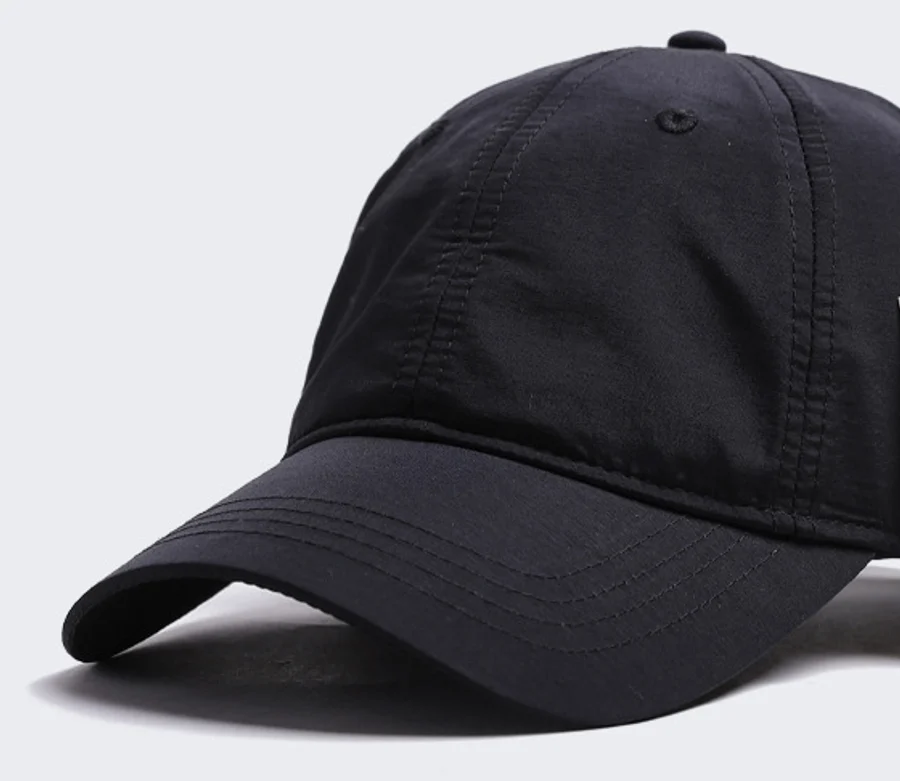
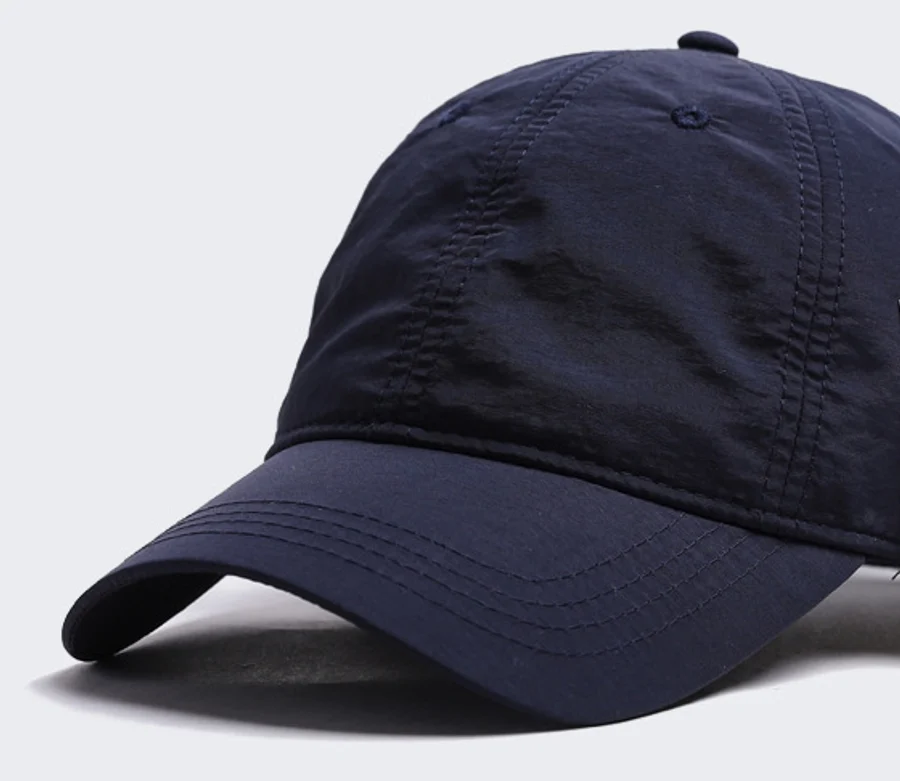
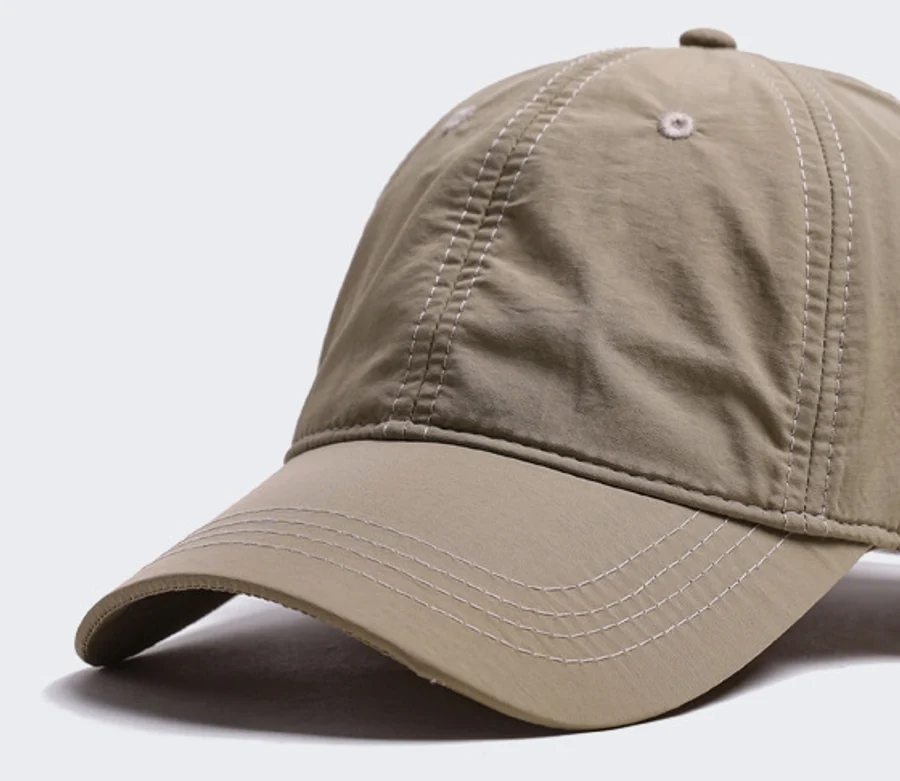
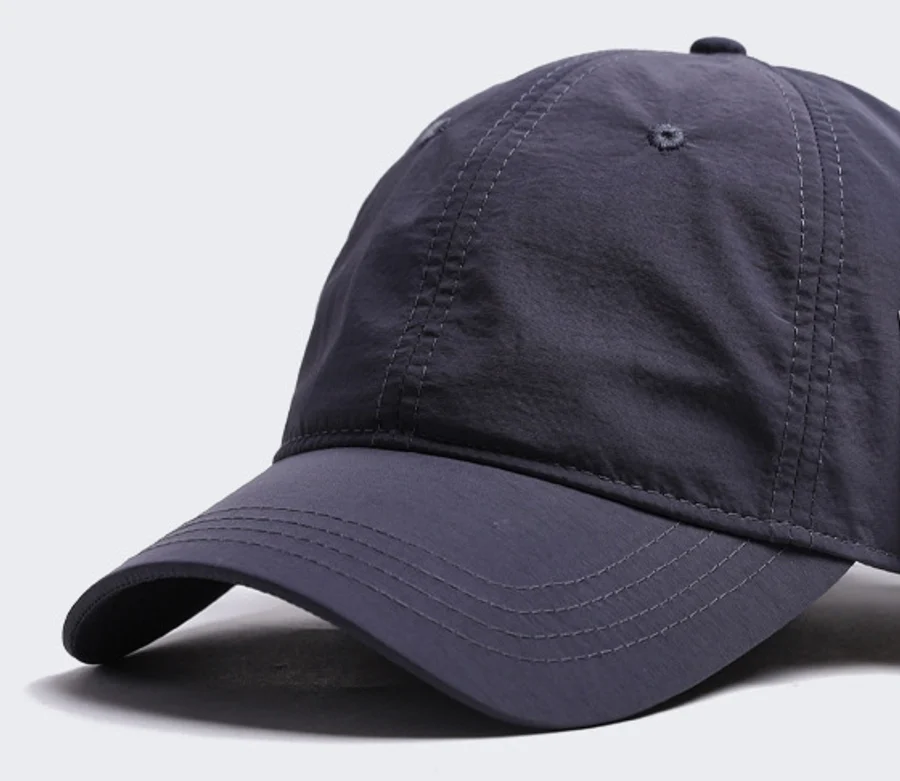
Why this case exists
A cap is a small object with an unusually public life. It is worn against the face, photographed more often than most garments, and judged first on shape and second on feel. In summer it is also judged on sweat. Those three things pull in different directions: shape wants structure, structure usually wants weight, and weight keeps water.
The brief we set ourselves was to keep the shape, lose the weight, and make the water leave quickly — without the cap announcing that it is a technical product. That last condition is the hard one, because the usual answers (mesh panels, contrast piping, a printed logo) all read as sportswear.
The brand logic we designed against
The reference point wasMUJI (無印良品), whose name translates roughly as "no-brand quality goods". The company was founded in Japan in 1980 and built its range on a simple argument: if the product is good, the label does not need to do any work. That argument has three consequences for a cap.
- No visible logo. The brand appears on a woven label inside the sweatband, not on the front panel.
- Function before decoration. Every visible element has to do something: the eyelets vent, the sweatband absorbs, the brim shades.
- A colour range that stays quiet. Black, navy, khaki, off-white — colours that do not date and do not need to match a season.
A cap built to those three rules cannot rely on graphics, so the shape has to carry the product. That is why the crown construction matters more here than in a logo-led cap.
The brief, in numbers
| Requirement | Target | Why |
|---|---|---|
| Shell weight | ≈ 200 gsm | Light enough to dry fast, heavy enough not to look cheap |
| Dry time | Under 40 min | Cotton twill takes 90+ min at the same thickness |
| Crown | Six panels, structured front | Holds shape with no logo to distract |
| Head size | 56–60 cm | Larger heads are underserved by one-size caps |
| Brim | Firm, 7 cm, curved | Physical shade, and it has to hold the curve |
| Branding | Woven label only | No front logo, in line with the reference brand |
Product architecture
Six panels, structured front
A six-panel crown gives two front panels with a centre seam, which is the shape most people picture when they say "baseball cap". The structure comes from a fusible interlining bonded to the two front panels and the front of the crown — not from a heavier shell. That distinction matters: adding weight to the shell would stiffen the cap and slow the drying, while the interlining adds shape without adding water retention.
The crown height is mid-profile, about 11.5 cm at the front. Higher reads as streetwear; lower reads as a dad cap and collapses when the wearer has a larger head, which is the failure this brief was written to avoid.
The sweatband does the comfort work
The single most under-specified part of a cap is the sweatband. Standard cotton tape is 2.5 cm wide and saturates quickly; this build uses a widened woven band — 3.5 cm — with a moisture-wicking finish. Wider means more contact area and more absorbent volume before it feels wet, which is the difference between a cap that can be worn for a run and one that has to come off.
The band is also where the cap is adjusted, so its construction has to survive repeated pulling. A woven band sewn flat into the seam holds better than a knitted one, which stretches and does not recover.
Brim: three layers, one curve
The brim is a layup: shell fabric, a PE board, and a lining, bonded and then pressed to the curve. The board thickness sets how the brim behaves — 1.2 mm holds a firm curve that shades the eyes and keeps its shape in a bag, while a thinner board droops after a season. Four rows of stitching at the edge are not decoration: they hold the layup together and stop the edge from rolling.
The trade-off is honest: a firm brim does not fold. If the buyer wants a packable cap, this is the wrong construction, and the fix is a soft brim or a moulded EVA — a different product at a different price.
The fabric decision
The shell is a 200 gsm nylon-rich plain weave with a water-repellent finish. Three properties drove the choice:
- Low water uptake. Nylon absorbs far less water than cotton and releases it faster; the woven structure gives it somewhere to go.
- Dry hand. The plain weave is smooth, so it does not feel clammy against the forehead even before it dries.
- Print and embroidery compatibility. A tight plain weave takes fine embroidery and a woven label without the pattern sinking into the texture.
The alternative — a polyester mesh — dries faster and vents better, but it reads as sportswear the moment it is seen from two metres away. For this brief the mesh belongs inside the cap, not on the outside, which is why the venting is handled by sewn eyelets at the panel junctions rather than by a mesh back.
Fit: the part most one-size caps get wrong
Most adjustable caps are built on a 56–58 cm block and closed with a strap. A wearer at 60 cm gets the strap fully open and a crown that sits high and shallow, which is why larger-headed customers describe caps as "sitting on top" rather than on the head.
The fix is not a longer strap; it is a deeper crown and a wider circumference at the base. This build runs to 60 cm with a crown depth increased by 8 mm over the standard block, and the sweatband is shaped rather than straight so it follows the head instead of cutting across it. The adjustment is a metal slide, not plastic, because the strap is the second thing to fail after the brim.
For a volume programme the honest answer is a size run: 56, 58 and 60 cm with a common crown, which removes the adjustment entirely and gives a better fit at every size. That is a different SKU structure, and it is worth doing above about 3,000 pieces per colour.
Sun protection, stated carefully
The brim is a physical shade: 7 cm of firm material covering the brow and the upper face. That is a real benefit and it can be described as coverage. It is not the same as a UPF rating, which requires laboratory testing of the finished fabric in the finished construction. Any page or hangtag that prints "UPF 50+" without that report is a claim the brand has to defend, so this case describes coverage and leaves the number to a test report.
Decoration, in the reference brand's language
The front panel carries nothing. The brand appears in three places: a woven label inside the sweatband, a small tonal embroidery on the back panel if the buyer wants one, and the hangtag. Tonal embroidery — one thread colour on a matching ground — is the most expensive-looking decoration per unit and the least loud, which is exactly the register a restraint-first brand needs.
If a front mark is required, a 3D puff embroidery at 6–8 mm height is the option that still reads as texture rather than as advertising. On a 200 gsm shell the front panel needs the interlining to support the foam; without it the puff collapses in the first wash.
What we would test before a bulk run
| Test | Method | Pass condition |
|---|---|---|
| Dry time | Soak 60 s, hang at 21 °C with airflow | Dry under 40 min |
| Brim recovery | Load 2 kg for 24 h, release | Returns to within 3 mm of original curve |
| Sweatband | Saturate, measure wicking height at 5 min | Wicks 20 mm+ upward |
| Shrinkage | Wash 3× at 30 °C, measure circumference | Under 1% (nylon, no cotton in the shell) |
| Strap fatigue | 500 open/close cycles | No slip, no metal flaking |
Where this design has limits
A case study that only lists strengths is a brochure. Three honest limits:
- It does not pack flat. The brim is the firmest part of the product. Travel retail and backpacks want a foldable cap; this is not that cap.
- The dry hand is not a soft hand. Nylon feels crisp. A customer who expects brushed cotton will read it as "thin" until they wear it in heat, which is where it wins.
- One size stops at 60 cm. Above that, a size run is the answer, and a size run changes the MOQ structure.
Why it suits a restraint-first brand
Three reasons, and they are the same three the brand's own philosophy states. The product does not need a front logo to be recognisable, because the crown shape carries it. Every visible part has a function — eyelets vent, band absorbs, brim shades — so nothing has to be explained away. And the colour range is quiet enough that the cap can sit in a summer collection without becoming a seasonal statement.
The fourth reason is commercial: the construction is simple to repeat. Six panels, one interlining, one brim layup, one woven label. A brand that reorders the same cap for three summers does not want a construction that depends on a supplier's memory; it wants a spec that can be re-cut identically.
If you are building something similar
Send the brief rather than the photo. The useful inputs are: the head size range you need to cover, whether the cap must pack, the decoration you intend (or the decision not to decorate), the colour count, and the quantity per colour. Those five answers decide the shell weight, the brim board, the sweatband and the MOQ — and they are the difference between a cap that reorders cleanly and one that has to be redesigned each season.
The reference brand on this page is named for context only. If you are working on a programme in this style, we will talk about your brief and your brand — not theirs.
Building a cap like this?
Tell us the head size range, whether it must pack, the decoration, the colours and the quantity. We come back with a spec, a sample date and a tiered price — usually within one business day.
Questions
Is 200 gsm nylon enough for a cap that holds its shape?
Yes, because the shape comes from the front panel interlining, not from the shell thickness. The 200 gsm shell gives the dry hand and the quick dry time; the interlining gives the structure. A heavier shell would only add weight and drying time.
How fast does it actually dry?
A wet shell at 21 °C with airflow dries in roughly 25–35 minutes, against 90+ minutes for a comparable cotton twill. The woven sweatband takes longest because it is thicker.
Will the brim survive being packed in a bag?
The brim is a three-layer layup with a PE board, which holds shape but does not fold flat. For a packable cap we would switch to a soft brim or a moulded EVA — a different product, with a different price.
What sun protection can be claimed?
Physical shade from the brim, measured as coverage of the face and neck, not an SPF or UPF number. A UPF claim needs laboratory testing on the finished fabric and a report to support it.
Copyright © 2026 HatsManufacture. Product development case. Brand names referenced belong to their respective owners and are used descriptively; no affiliation or supply relationship is claimed.